
How to Check Effingham Warrants
An Effingham County warrant check is not an online name search. The official county warrant notice states that active-warrant inquiries are handled in person with picture identification. Staff will discuss a warrant only with the person it names. The Warrant Division listing gives a public contact number, but deputies do not discuss active status over the phone. Use a call only to confirm the counter, current hours, and acceptable ID. One wrinkle is worth noting: the general Sheriff address is 500 W First Street, while the division listing shows 502 W First Street. Confirming which door to enter before you drive over saves a trip.
- Review the county notice and decide whether the matter is county, city, traffic, juvenile, or federal.
- Call 912-754-3449 to confirm logistics, not to request status by phone.
- For your own county status, appear with government-issued picture ID.
- For a city or traffic matter, contact the clerk that issued the citation or set the hearing.
- If a warrant may exist, ask a Georgia attorney about safe appearance, bond, or court action.
Effingham Has No Public Roster
Effingham County publishes no public active-warrant roster, search box, download, photo gallery, or most-wanted list. The county page describes its process instead. Warrants arrive daily, get entered into NCIC, and are assigned to deputies for personal service. That account does not make NCIC a public tool, and an old web capture cannot prove current status. A blank result from some unrelated site is no substitute for the Warrant Division procedure. The county Crime Tip Form and Tip411 service accept reports and alerts, but neither confirms a warrant. Effingham County warrant records can be verified only through the responsible office, and a blank search never proves that no warrant exists. Note: A web page can describe policy, but only the responsible agency and issuing court can confirm a current record.
Types of Effingham County Warrants
Effingham County lists probation, bench, juvenile, criminal, child-support, and "personal" warrants. That last phrase is a local label with no published definition, so treat it as unnamed rather than inventing a legal meaning. Georgia courts may also issue search and arrest warrants. The case type and the issuing court control which route you take.
| Type | How It Arises | First Route |
|---|---|---|
| Arrest warrant | A judge finds probable cause | Warrant Division and issuing court |
| Bench warrant | A required court duty is missed | Clerk for the missed session |
| Traffic or FTA | A ticket date or court duty is missed | Issuing traffic court |
| Juvenile warrant | A confidential youth matter | Authorized Juvenile Court route |
| Probation or support | A supervising or court order controls | Issuing authority |
Bring ID to Effingham County
The in-person rule is narrow. The affected person brings picture identification and asks about their own Effingham County warrant status. The Sheriff does not offer that service to a caller asking about a relative or another private person, which keeps a sensitive check tied to verified identity. Prepare for a consequence if an active warrant turns up. Georgia guidance warns that a person who appears to check may be taken into custody. A lawyer can help you approach the court, weigh whether a voluntary surrender route exists, and sort out bond questions. Clerks explain filing and calendar mechanics, but they cannot give legal advice.
Effingham Sheriff Warrant Division
502 W First Street
Springfield, GA 31329
912-754-3449
Effingham Warrant Record Fields
Effingham County publishes no completed sample warrant. A court or law-enforcement record may still carry common fields used to route a case, so read them in context. A service entry alone does not show how the court case ended.
| Identifier | A case or warrant number assigned by the source |
|---|---|
| Subject | Identity details used by authorized staff to avoid a false match |
| Process | The alleged offense, missed duty, or court authority |
| Issuing court | The court that controls recall or dismissal |
| Bond | A release condition, when permitted |
| Status | Issued, served, recalled, dismissed, or removed from a system |
Effingham Status Words Matter
Status words describe different events, and treating them as synonyms sends people to the wrong counter. Effingham County says its Warrant Division cannot dismiss a warrant. Guyton's public procedure separately describes service, system removal, and return of a canceled warrant to Court Service.
- Issued
- A court has authorized the warrant.
- Active
- The responsible system still treats it as enforceable.
- Served
- Law enforcement completed the stated service event.
- Recalled or dismissed
- The issuing court ended the warrant under its process.
- Removed
- An authorized entry left GCIC or NCIC. This does not describe the whole case.
Keep any court order, release, receipt, or bond paper. Then verify the update with the clerk and the proper Effingham County law-enforcement office.
Who Handles Effingham County Warrants
Courts issue warrants, and law enforcement serves them. In Effingham County, Superior Court holds broad felony and civil jurisdiction. State Court handles misdemeanors and traffic within its authority and may issue search and arrest warrants. Magistrate Court handles preliminary criminal functions, bail in suitable cases, and local pre-warrant and bad-check applications. Municipal courts run city ordinance and traffic dockets. The Clerk of Superior Court also serves State Court by statute and performs Juvenile clerk duties. The judicial complex sits at 700 N Pine Street, and Probate Court is there too, though it is not a general criminal-warrant office. Identify the court named on the document before choosing a counter.
The process is: court issues → Sheriff or authorized city officer serves → court controls recall or dismissal → authorized staff update the system.
Effingham Bond Is Separate
Booking, bond, and warrant status answer three different questions. The official bond page describes a card payment as a cash bond. It warns that payment is non-refundable, that another hold can delay release, and that paying does not guarantee immediate release. After the case ends, a cash bond goes back to the arrestee, not necessarily the payer. Speak with jail staff about other holds first. If bond is returnable to a surety, that surety must appear and complete the form. The Effingham County Sheriff does not mediate a private dispute between payer and arrestee. The county's public bond interface records these limits on its face.
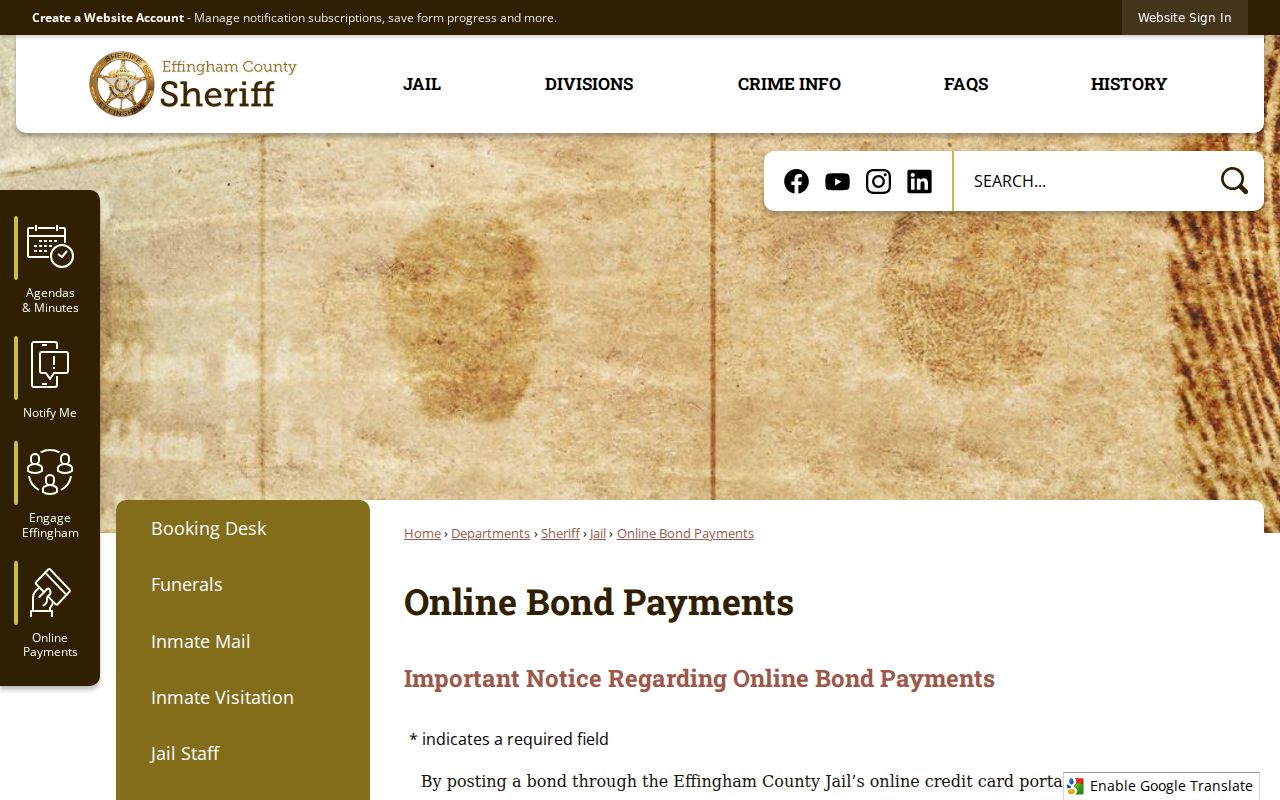
Bond never replaces the issuing court's order, and release, hearing, and system updates remain distinct steps.
Resolve an Effingham County Warrant
Ask the issuing court first. Call the clerk. Find out what official act the court requires, whether bond applies, and how counsel can arrange a safe surrender. Deputies may serve the paper, but only the issuing court can recall or quash its own Effingham County warrant. Do not assume online payment clears anything. A traffic payment can still need a court release and DDS processing. Bond buys release while the case stays open. A city clerk may accept payment before court yet need a judge's direction after a missed date, so keep every confirmation.
Important: Ask a Georgia attorney and the issuing court about the safest lawful step before appearing on a possible active warrant.
Effingham Traffic FTA Records
Miss a traffic court date in Effingham County and several records start moving at once, though none of them equals a warrant lookup. Georgia Courts keeps no central ticket database. A fresh citation may take seven to 21 business days to surface through a court-linked vendor, so give it time before panicking. If the ticket never shows, call the court printed on the citation. That court, not a vendor, holds the answer.
Georgia DDS adds another clock. An FTA suspension can kick in 28 calendar days after DDS gets notice from the court, and fixing it starts with the court too. Make sure the court sends its release, confirm DDS has it, then finish reinstatement. The current table lists a $90 FTA reinstatement fee, but the live agency page governs the actual methods and charges. Rincon, Springfield, and Guyton each run their own municipal routes. The Effingham traffic warrant process runs through the issuing court, not a payment portal dressed up as a warrant search.
Access to Effingham Warrant Records
Georgia's Open Records Act opens the door to Effingham County agency records, though exemptions, redaction, and court rules still shape what you get. A request works best for a policy, a blank form, a fee schedule, a retention rule, or a monthly count. Ask for those. It cannot substitute for the Sheriff's identity-specific warrant check.
Key Rules:
O.C.G.A. §50-18-70 defines public records broadly while preserving exemptions.
O.C.G.A. §50-18-71 supplies a three-business-day response framework.
O.C.G.A. §15-11-708(b) generally protects juvenile records unless an exception applies.
Effingham County routes record requests through the county open-records portal, which covers Sheriff records. Spell out the agency, the date range, the record, and the format, and note that you will pay lawful costs.
Effingham Pre-Warrant Applications
Magistrate Court gives Effingham County residents a pre-warrant option when law enforcement has not sought an arrest warrant. The incident had to happen inside the county. You appear in person, file the official form, show ID, and swear the details are accurate; a police report is strongly encouraged. The current procedure sets a $30 fee per applicant effective July 1, 2026, plus three personal-service attempts. If a new valid address comes after those attempts fail, a $10 fee applies. Nothing is heard until service is completed or the case is dismissed, and at the hearing the applicant must prove probable cause. A judge can find probable cause as to any participant, so accuracy matters. Georgia's 2026 HB 1131 rewrote this framework, so follow the current Effingham instructions and blank Rule 24.3 form rather than an old checklist.
Effingham City Court Handoffs
A city citation can stay in municipal court. Rincon holds court in its police department courtroom. Springfield sends questions through City Hall and its police and court clerk, while Guyton holds monthly sessions and publishes a detailed warrant-service procedure. None of the cities' payment links searches county criminal warrants. Guyton's SOP shows one local chain: the records clerk attaches a service sheet, officers attempt service, and after at least two failed tries the warrant goes to E-911 for GCIC and NCIC entry. E-911 removes the entry once service is done, and the officer logs the event. That is a city process, not a countywide rule.
Note: Ask the city clerk about its docket, and ask the county division only about the inquiry its policy covers.
Federal Warrants Use Savannah
Effingham County sits in the Savannah Division of the Southern District of Georgia. A federal complaint, indictment, warrant, or fugitive matter never becomes a county record just because the person lives here. Start public docket research with PACER or the federal clerk, and take service questions to the U.S. Marshals. PACER may show a public docket or order, but sealed material may not appear, and a docket search does not confirm status. The Savannah clerk lists 912-650-4020, a division site at 8 Southern Oaks Court, and mail at 124 Barnard Street. Verify current Marshals contact details, since official pages have shown different task-force numbers.
Effingham Amnesty Was Not Found
Effingham County runs no amnesty program that its offices themselves announce. No roundup, mass dismissal, recurring safe-surrender event, most-wanted roster, or reward schedule covering 2024 through 2026 appears on any Effingham County court, city, or Sheriff channel. That silence is not proof a future court event can never happen. So skip any social post, old news item, or commercial summary promising relief; none of them can establish that a program stands. A genuine program would come from an official court, county, city, or Sheriff channel, and it would state its dates, who qualifies, and what a person must do. Even then, scope can be narrow. One official event may cover a single city court, one type of citation, or a short filing period, so read its terms before counting on it. A bond page, a tip form, or a payment vendor is not amnesty.
Without a program, use the ordinary route in Effingham County. Ask the Warrant Division about personal county warrant status. Ask the issuing court about a recall, the municipal clerk about a city failure to appear, Magistrate Court about applications, and the court plus DDS about a traffic suspension. That court will say whether a hearing, filing, payment, appearance, bond, or judge's order resolves the matter. Keep the official paperwork, and confirm linked updates with the clerk, Warrant Division, city police, jail, or DDS as needed. No single receipt proves every record changed. For tips, Effingham County's Crime Tip Form and Tip411 take public reports and send alerts, but they publish no most-wanted roster and never confirm personal warrant status. Call 911 in an emergency; for a record question, use the records office or court rather than sending sensitive facts through a tip form.
Effingham County Warrants by City
Effingham County counts three incorporated cities. Rincon leads by the 2020 Census figure, with Springfield next and Guyton after that. Each city runs its own police department and municipal court for local warrants. The city pages keep those contacts up front and route county matters to the Sheriff or county court.
Rincon Warrant Records
10,934 residents · Police and Municipal Court handle city matters.
Springfield Warrant Records
2,703 residents · The police/court clerk is the first docket contact.
Guyton Warrant Records
2,289 residents · City Court and a public SOP show the local route.